

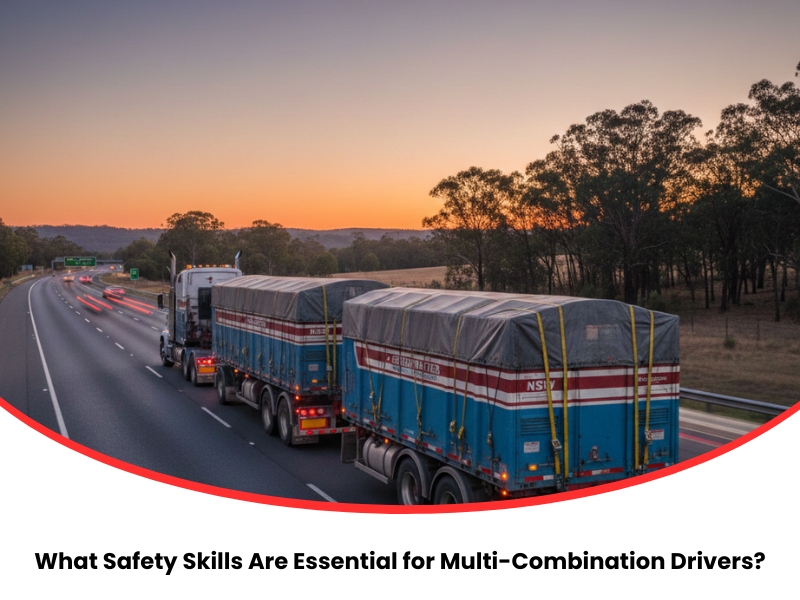
Driving a multi-combination truck is one of the most technically demanding roles in the transport industry. With multiple trailers, additional articulation points, and significantly greater braking and turning requirements, these vehicles demand a level of precision and awareness that goes far beyond standard heavy-vehicle driving. As freight movement across Sydney, Penrith, Campbelltown, the Central Coast, Wollongong, and Newcastle continues to grow, the need for highly skilled MC drivers has never been stronger.
Unlike generic truck-driver safety advice found on many training websites, the skills required for safely operating a multi-combination vehicle are deeper, more technical, and far more specialised. For drivers pursuing their MC licence, understanding these skills is essential — not only to pass assessments but to build a long, reliable career in the industry.
Thorough Pre-Trip Inspections for Multi-Trailer Rigs
Every safe journey begins long before starting the engine. Multi-combination drivers must perform more detailed pre-start checks than those driving rigid or single-trailer vehicles. Key inspections include:
- Couplings, turntables and kingpins
- Air hoses, electrical leads and emergency lines
- Brake testing across multiple trailers
- Dolly alignments and articulation points
- Tyre condition and matching pairs
- Clearance and height checks
- Load restraint equipment and anchor points
The NSW Heavy Vehicle Driver Handbook reinforces the importance of vehicle checks, particularly for coupling integrity and braking systems, due to the heightened risk of separation or loss of control in multi-trailer setups. These checks ensure your entire combination is safe — not just the prime mover.
Understanding Load Dynamics Across Multiple Trailers
Load distribution becomes significantly more complex in MC operations. Weight must be properly balanced not only within each trailer, but across the entire combination. Uneven or shifting loads dramatically increase risks, including:
- Trailer sway
- Jack-knifing
- Overturning on bends
- Excessive braking instability
- Poor traction on inclines/declines
According to the Load Restraint Guide (National Transport Commission), up to 20% of heavy-vehicle incidents involve poor load security, incorrect restraint systems or preventable load movement.
MC drivers must know:
- How load shift affects trailer articulation
- How to distribute weight to maintain stability
- When to re-check restraints during the trip
- How to identify early signs of instability
This is where structured pathway training matters. Before advancing to MC class, many drivers complete Heavy Combination (HC) truck licence training, which introduces load-handling fundamentals essential for MC operations:
Advanced Vehicle Control & Manoeuvring Skills
MC trucks require precision manoeuvring practices that differ noticeably from single-trailer combinations. Critical skills include:
- Smooth gear management under heavy load
- Anticipating trailer cut-in and off-tracking
- Wide-arc turning techniques
- Controlling trailer sway on open roads
- Accurate reversing of long combinations
- Progressive braking and downhill speed management
High-Level Defensive Driving Behaviours
Defensive driving is universally promoted across the industry, but for MC drivers, it is not merely a suggestion — it is a survival skill.
The Heavy Vehicle Safety Competency (TLIC3037) outlines defensive behaviours as mandatory, including hazard anticipation, maintaining extended following distances, and consistently monitoring blind spots across multiple trailers. MC-specific defensive driving involves:
- Watching trailer lines during lane changes
- Accounting for lag in vehicle response
- Managing multiple blind-spot zones
- Understanding how weather magnifies risk
- Predicting risky driver behaviour from smaller vehicles
Defensive driving also touches on education and cost considerations. Many new drivers research why HC licence training costs can differ across schools before upgrading, which gives insight into training quality and depth — factors that can influence later MC safety.
Fatigue Management & Driver Wellness
Long combination work often involves long-distance travel. Fatigue is a leading causal factor in heavy-vehicle incidents (NHVR), reducing reaction times, cognitive function and hazard recognition. MC drivers must master:
- Legal fatigue limits and work/rest hours
- Correct logbook recording
- Early identification of microsleep signs
- Nutritional strategies for concentration
- Hydration and sleep consistency
- The ability to self-assess fitness for duty
A multi-combination rig leaves zero margin for error — and fatigue compounds every risk.
Mastery of Compliance, Laws & Safe Operating Procedures
MC drivers face stricter compliance requirements because of the additional risk associated with hauling long multi-trailer combinations. Drivers must fully understand:
- Heavy Vehicle National Law (HVNL)
- Mass, dimension and loading rules
- Access-restricted or permit-only routes
- Chain of Responsibility (CoR) obligations
- Emergency breakdown protocols
- Safe coupling and uncoupling procedures
- Work diary and fatigue regulations
Compliance also includes licence-class progression. If a driver’s paperwork or application encounters issues, knowing how to navigate processes such as appealing a rejected HC licence application becomes important.
Hazard Recognition & Environmental Adaptation
Multi-combination drivers must adapt to changing environments and road conditions more dynamically than drivers of smaller heavy vehicles. Understanding how external factors influence long combinations is essential for maintaining vehicle stability and control. Key hazards include:
- Crosswinds are causing trailer sway
- Reduced traction during rain, especially for empty trailers
- Steep descents requiring engine braking and gear-holding techniques
- Tight metropolitan roads with limited turning space
- Rural routes with wildlife, flooding or unsealed surfaces
Transport for NSW emphasises that the weather multiplies the risks associated with long combinations.
Emergency Response & Incident Preparedness
High-risk situations for MC drivers include:
- Load shift
- Tyre blowouts
- Trailer sway escalation
- Mechanical failures
- Coupling issues
- Unexpected traffic stops
Drivers must know:
- How to stabilise the vehicle through progressive braking
- How to safely pull over a long combination
- How to deploy triangles/emergency markers
- How to isolate the problem trailer if necessary
- How to communicate hazards to other road users
Emergency competence is one of the strongest markers of professional MC driving.
Final Thoughts: MC Drivers Don’t Just Drive — They Manage Risk at Every Second
Operating a multi-combination vehicle demands a higher level of awareness, precision and responsibility. With greater mass, additional articulation points and more complex load dynamics, MC drivers must rely on refined skills to maintain safety across every journey. Securing your MC licence is just the start — true professionalism comes from applying these advanced safety practices consistently on the road.
For drivers across Campbelltown, Penrith, Sydney, Newcastle, Wollongong and the Central Coast, mastering these safety skills supports better decision-making, reduces risk, and builds long-term confidence in every driving environment.