
If you’re driving (or planning to drive) heavy vehicles in NSW, the most confusing part usually isn’t the letters on the licence — it’s knowing when the jump from rigid vehicles to combination vehicles is actually worth it.
In Sydney, that decision is often driven by the work in front of you: metro freight, construction supply runs, tipper-and-dog style operations, port container movements, and linehaul opportunities that start opening up once you’re confident with articulated setups.
This guide explains NSW licence options in plain English, with a deliberate focus on the transition into Heavy Combination (HC) — because that’s where the vehicle handling, the skill set, and the job opportunities noticeably shift.
Rigid vs combination vehicles: the simplest way to understand the jump
A “rigid” vehicle is one solid unit: the cab and the load area are on the same chassis. Think many tray trucks, tippers, concrete agitators, and a lot of metro delivery trucks.
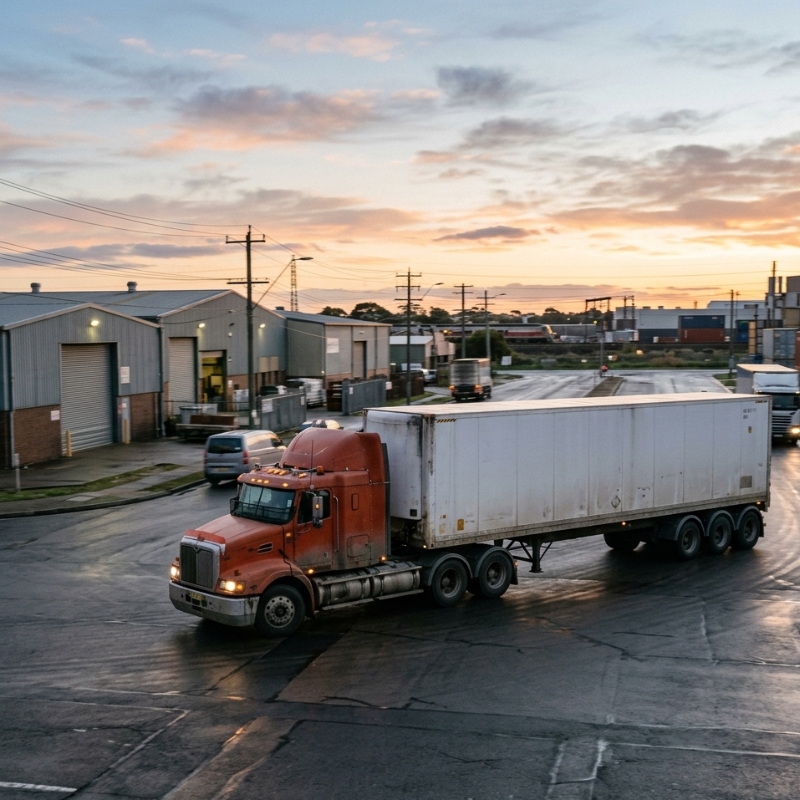
A “combination” vehicle is made up of more than one connected unit — a truck plus a trailer, or a prime mover plus a semi-trailer. Once you’re dealing with heavier trailers, additional pivot points, coupling systems, and more complex reversing, you’re in combination territory.
One concept that helps drivers make sense of the difference is the 9-tonne trailer threshold (commonly referenced in licence class explanations): as trailers get heavier and combinations get more complex, the licence class you need changes, and that’s where the move into HC starts to matter.
For the official NSW overview of licence types and heavy vehicle licensing, you can cross-check the current wording and requirements on the NSW Government site: Getting a heavy vehicle licence (NSW Government)
The NSW licence classes you’ll see on the “rigid to combination” pathway
Even though the focus here is on HC, it helps to understand the stepping stones drivers commonly move through.
LR and MR: early steps into rigid trucks
These are common entry points for drivers moving from a car licence to commercial vehicles.
They’re useful if your goals are local delivery, light freight, or building confidence in a truck environment, but many Sydney drivers treat them as stepping stones if they want heavier work.
HR: the licence where many drivers build real confidence
HR is where a lot of Sydney drivers become genuinely comfortable with bigger vehicles, heavier braking distances, and driving a large footprint around tight streets, roundabouts, loading zones, and industrial estates.
HR commonly suits work like:
• metro distribution and deliveries
• rigid tippers and construction-support trucks
• concrete agitators
• some bus operations (depending on vehicle type and conditions)
It’s also the licence class where many people realise: “I’m comfortable driving big… but towing and articulation is a different world.”
HC: Where you become a combination driver
HC is often the class that unlocks the combination work people have in mind: prime movers with semi-trailers, and heavier rigid–trailer combinations that go beyond what rigid classes are typically designed for.
In NSW, upgrading into HC generally involves prerequisites (including holding periods and testing/assessment pathways). Those details can change over time, so always confirm eligibility using official information before you plan your timeline.
MC: the top tier for multi-combinations
MC is the highest class and covers multi-combination setups such as B-doubles and other multi-trailer combinations (where permitted and relevant).
In practice, many drivers don’t need MC immediately. HC is commonly the “gateway class” that builds the combination handling fundamentals MC relies on.
Why HC changes your driving (not just what you’re allowed to drive)
A lot of people assume the progression is simply “bigger vehicle = next letter.” HC is different because it changes how you control the vehicle every minute you’re on the road.
Once you move into combinations, you need to manage:
• how the trailer tracks through turns (off-tracking)
• how you plan space and timing in traffic
• how you reverse with a pivot point behind you
• how you brake and leave space (especially when loaded)
• how you handle coupling routines and safety checks
This is why two drivers can both be excellent on HR, but one feels like a beginner again the first time they take a semi-trailer through a tight Sydney industrial corner.
The practical skill jump: rigid confidence doesn’t automatically transfer
Rigid driving teaches judgment, mirror use, lane placement, and braking discipline.
Combination driving adds:
• pivot management (where the trailer “follows” and where it doesn’t)
• tail swing awareness (especially when turning from tight lanes)
• corner setup that starts earlier and needs more room
• reversing that requires you to think in angles, not straight lines
When HR makes sense vs when HC makes sense in Sydney
Here’s a practical way to decide, based on typical work and vehicle types you’ll actually see around Sydney.
HR makes sense if your day-to-day looks like this
• mostly metro deliveries with a single rigid vehicle
• construction support work where rigid tippers are standard
• driving tasks that rarely involve heavier trailer combinations
• you’re building time and confidence before stepping into articulation
HR is still “real driving” in Sydney: narrow industrial streets, constant merges, roundabouts, loading docks, and unpredictable congestion.
HC makes sense if you’re moving toward any of these
• prime mover + semi-trailer work
• heavier trailer setups where articulation and coupling are part of the role
• employers expecting combination capability (even for metro-based freight)
• a longer-term pathway where MC might eventually be relevant
If your goal is “I want to operate combination vehicles confidently and safely,” HC is often the most logical target because it’s where combination control becomes the main skill.
Quick Q&A: If I’m already good at HR, how will HC feel on day one?
For many drivers, HC initially feels like relearning three things at once:
• turning (you set up earlier and track the trailer constantly)
• reversing (small steering changes have bigger consequences)
• space (gaps that felt comfortable on rigid start to feel tight fast)
That’s normal. The point of HC development is to replace “guessing” with repeatable systems.
What you can drive: HR vs HC vs MC in plain English
Instead of getting stuck in technical wording, use this mental model.
HR: “large rigid vehicles”
• big rigid trucks and buses (typically 3+ axles)
• Towing is generally limited compared to combination-focused classes
HC: “The everyday combinations in freight”
• prime mover + semi-trailer type setups
• heavy rigid + trailer combinations that move beyond rigid-only territory
• the class that builds core combination handling skills
MC: “multiple trailers / higher complexity combinations”
• multi-combination setups such as B-doubles (and other multi-trailer combinations where relevant)
• relies heavily on the trailer control and judgement built through HC-level experience
If you’re planning a career move, the better question is often: “What will I be expected to control confidently in real conditions?”
A practical upgrade path that keeps you employable (and not overwhelmed)
A sensible pathway for many Sydney drivers looks like:
• build confidence and hours on rigid vehicles
• transition into combination handling via HC when your goals demand it
• consider MC later, once combination control feels natural
Where people struggle is trying to “skip the skill development.” Even if rules and pathways allow progressions, your competence still needs to match the complexity.
Quick Q&A: Can I go straight from HR to MC in NSW?
Eligibility and pathways can vary, and there are prerequisites for moving into MC. Even when progression is possible, many drivers find HC-style combination foundations make MC training far more manageable because you’re not learning articulation and multi-combination complexity at the same time.
The Sydney reality: combinations change how you handle common city situations
Sydney isn’t just “traffic.” It’s a specific mix of:
• short merging lanes and heavy congestion
• tight industrial roundabouts and kerbed corners
• steep driveways, docks, and awkward yard entries
• frequent lane changes from other drivers who misjudge your space
• busy freight corridors and container routes
Combination vehicles amplify the consequences of small errors. These situations commonly challenge new combination drivers.
Roundabouts and tight turns
With a trailer, you often need a wider setup. If you turn like you would in a rigid:
• the trailer can clip kerbs, signage, or traffic islands
• you can track into adjacent lanes without meaning to
Lane changes in dense traffic
On a rigid schedule, you can sometimes slot in with less planning. With a trailer, you need:
• more time to plan
• cleaner gaps
• disciplined mirror timing and lane commitment
Reversing into docks or tight yards
Many drivers describe the early stage like this: “I know what I want the trailer to do, but my hands do the opposite.” That’s not a personal flaw — it’s because reversing a combination is a learnable system, not a talent.
The combination-driver checklist: are you ready to move into HC?
You don’t need to be perfect, but you should be stable in the fundamentals.
You’re usually ready to step into HC development if:
• you hold lane position confidently without constant over-correction
• you use mirrors habitually (not only when something feels wrong)
• you plan braking early and smoothly, even in stop-start traffic
• you can reverse a rigid vehicle calmly and methodically
• you’re comfortable managing blind-side risk and tight spaces
• you’re willing to slow down to stay accurate rather than rushing
If that sounds like you, HC often becomes the most productive “next step” because it builds combination control in a structured way.
What HC training should actually focus on (beyond “pass the assessment”)
Even when you’re not planning to do linehaul straight away, the safest combination drivers tend to build the same core capabilities.
Coupling and safety checks
• understanding connection points and safety procedures
• developing a routine so you don’t miss steps when distracted
Turning and tracking control
• learning how different trailer lengths behave
• training your eyes to monitor tracking through mirrors naturally
Reversing systems
• straight-line control first
• controlled corrections (small inputs, deliberate pauses)
• knowing when to reset instead of “chasing” the trailer
Managing momentum and braking
• smoother throttle control
• braking that avoids unnecessary trailer push
• leaving space so you’re not forced into late decisions
If you want a clearer picture of what combination-focused learning actually covers (coupling routines, tracking, reversing systems, and safe space management), have a look at heavy combination vehicle training to see what that pathway involves.
Quick Q&A: Is it normal to feel nervous moving into combinations?
Yes. A healthy level of nerves is your brain recognising the complexity increase. The goal isn’t to “tough it out” — it’s to replace uncertainty with systems: a routine for checks, a method for reversing, and a repeatable approach to corners and space.
How to decide between staying on HR or stepping into HC
If you’re stuck, use this decision lens.
Choose HR as your “working class” if:
• your current role is rigid-based, and that won’t change soon
• you rarely tow heavier combinations
• your employer pathway doesn’t require combination capability yet
Choose HC as your “career class” if:
• You want access to prime mover and semi-style work
• You want a combination confidence (not just a licence letter)
• You’re aiming to expand opportunities beyond rigid-only roles
• You want a foundation that later makes MC more achievable
For Sydney-based drivers weighing up the next step, it can help to review a structured approach to moving from rigid to combination vehicles so you can align your licence progression with the kind of combination work you’re aiming for.
Common misconceptions that hold drivers back
“HR covers all trucks”
HR covers a lot, but combination vehicles introduce different legal and practical requirements. If the work involves prime movers, semis, or heavier trailer combinations, HC is often the relevant step.
“HC is just HR with a trailer”
HC is a genuine skill shift: turning geometry, reversing behaviour, braking dynamics, and coupling routines all change.
“I’ll get MC ASAP and skip the rest”
Even where progression is possible, skipping solid combination foundations often leads to slower progress, more stress, and unsafe habits. HC is where many drivers build the control that makes everything else easier.
Final FAQ
What’s the main difference between rigid and combination vehicles?
Rigid vehicles are one unit on a single chassis. Combination vehicles involve a truck and trailer (or prime mover and semi-trailer), which introduces pivot points, tracking changes, and more complex reversing.
What licence class is the real “step into combinations” for NSW drivers?
For most drivers, Heavy Combination is the class where combination handling becomes a core skill — not just occasional towing.
When does upgrading to combination vehicles make sense in Sydney?
It usually makes sense when your work goals include semi-style freight, heavier trailer combinations, or roles where employers expect combination capability.
Is HC only for highway work?
No. Many combination roles operate around metro freight corridors, industrial estates, and logistics hubs. The skills matter just as much in tight Sydney environments.
Do I need to be an expert reverser before I start combination training?
No — but being calm and methodical helps. Combination reversing is taught as a system, and most drivers improve quickly with structured practice.
What’s a practical next step if I’m leaning toward HC?
A practical next step is to match your goal vehicles to the skills you’ll be assessed on (especially coupling, reversing control, and safe turning lines), and then use heavy vehicle training in Sydney as a reference point for what combination-focused preparation typically includes.