
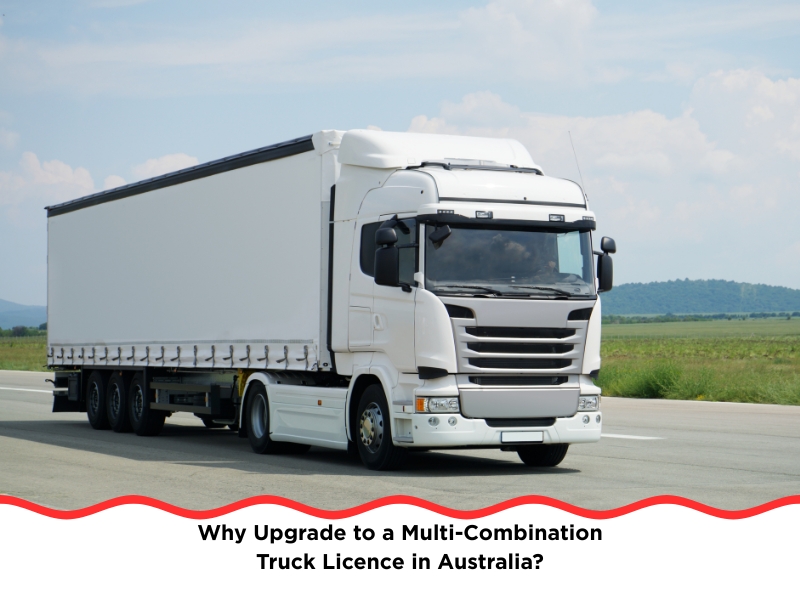
Drivers upgrade to a multi-combination truck licence to get better pay, drive more advanced vehicles, and open up flexible career paths. Getting a multi‑combination licence is a big step in your driving career. It’s not just about handling heavier gear — it’s about stepping into jobs that need sharper skills and more responsibility. If you’re in NSW, understanding what an MC licence actually covers, how it compares to other heavy vehicle licences, and what it can do for your work prospects will help you determine if the upgrade makes sense. In this blog, you’ll get a clear look at what an MC licence allows, what it costs, how to get it, and what to avoid along the way.
What vehicles can you drive with a multi-combination licence in NSW?
A multi‑combination (MC) licence gives you access to the largest and most complex rigs legally allowed on the road in NSW. That means B‑doubles, road trains, and more. It also covers everything a Heavy Rigid (HR) or Heavy Combination (HC) licence does — so you’re not limited to one type. You’ll be qualified to drive:
- B‑doubles — two trailers linked behind a prime mover
- Road trains — ordinary for long hauls and regional loads
- Low loader dollies and trailer combos — for heavy machinery
- All vehicles that fall under HR and HC classes
If you’re ready to explore your training options, start with reliable training paths for your multi‑combination licence in NSW. Having this licence means you can handle almost any heavy‑vehicle combination on NSW roads, which opens up a wide array of driving roles.
What is the difference between a heavy combination licence and an MC?
The main difference lies in what you’re legally allowed to drive and the level of skill required. To put the MC licence in context, here’s how it compares to other NSW heavy vehicle licence classes:
| Licence Type | Vehicles Covered | Common Uses |
| LR (Light Rigid) | Small trucks, minibuses (over 4.5 tonnes GVM, up to 8 tonnes) | School buses, courier vans, and small freight |
| MR (Medium Rigid) | Two-axle trucks and buses (over 8 tonnes GVM) | Waste trucks, delivery trucks, and local buses |
| HR (Heavy Rigid) | Trucks/buses with three or more axles | Coach driving, large construction vehicles |
| HC (Heavy Combination) | Prime mover + single semi-trailer, or HR vehicle + trailer (over 9 tonnes) | Freight, container transport |
| MC (Multi Combination) | B-doubles, road trains, low-loader dolly combinations | Interstate freight, long-haul transport, mining logistics |
If you’re comparing licence classes or planning your next upgrade, understanding the truck licence process in NSW can help clarify the steps involved and what to expect at each stage.
What common mistakes do drivers make in the heavy combination licence test?
It’s easy to underestimate the HC or MC driving test. A lot of candidates think it’s just another drive around the block — but there’s a bit more to it. The test looks closely at your ability to manage risk, carry out safety checks, and operate your vehicle under real-world pressure.
- Underestimating the importance of pre‑drive inspections (checking brakes, tyres, coupling). Missed faults often cost marks.
- Not fully understanding the difference in handling: MC vehicles respond differently when loaded, turning, reversing or braking.
- Skipping study of the knowledge test topics — road rules, load restraint, weight distribution, rules for combination vehicles
- Not practising enough in the actual vehicle type (manual vs automatic, dolly vs trailer), you will be tested on
- Failing to meet medical or vision requirements — these are non-negotiable and will prevent you from proceeding if not addressed ahead of time.
For extra preparation, you can examine the common mistakes in heavy combination licence practice tests to understand where candidates often lose marks.
How do you prepare for multiple combination licence requirements in NSW?
To meet MC licence requirements in NSW, you must be properly trained, medically cleared, and assessed by a licensed provider. Preparation encompasses both theoretical aspects (road rules, load limits) and practical skills, such as reversing, coupling trailers, and conducting pre-trip inspections. Steps to prepare include:
- Make sure you already hold a Heavy Rigid (HR) or Heavy Combination (HC) licence for at least one year
- Study for and pass the MC knowledge test and complete the necessary eyesight and medical checks to commercial standards
- Book the Heavy Vehicle Competency Based Assessment (HVCBA) via an accredited Registered Training Organisation (RTO)
- Practise extensively in vehicles similar to what you’ll be assessed on — coupling, reversing, and extensive trailer control.
- Review official handbooks: the Heavy Vehicle Driver Handbook, Load Restraint Guide, and Road User Handbook.
Good prep reduces the risk of test delays or having to re-sit your multi combination truck licence assessment.
How does a multi-combination truck licence improve your job options?
With an MC licence, you become eligible for more specialised and higher-paying driving roles that other licence classes don’t qualify for. Here’s how your job options expand:
- Access to more specialised roles: long‑haul freight, interstate or cross‑border hauling, specialised heavy machinery transport
- Higher pay rates: MC‑licensed drivers are often paid more due to greater skill, responsibility, and the scope of what they can operate
- Greater demand in remote and regional transport sectors, especially for road trains, B‑doubles, and agricultural transport
- Flexibility — with MC, you can drive most heavy vehicle combinations except lighter licence classes’ vehicles
- Improved career development: MC can act as a stepping stone into supervisory or lead driver roles
For a broader understanding of licensing pathways, it is helpful to understand the driver licence classes in New South Wales.
How much does a heavy combination licence cost in NSW?
The cost of getting your HC or MC licence in NSW isn’t just about the government testing fees. It includes medical checks, training with an accredited provider, and vehicle hire if you’re not using your own truck. While prices vary, especially for MC upgrades, the total can reach several thousand dollars — so it pays to budget carefully and choose the right training path. Key costs involved include:
- Knowledge test fee — around $57, paid to Service NSW when booking the written test
- Driving test or HVCBA assessment fee — around $70, depending on the assessment method used
- Medical examination — varies, but expect around $120–$200 for a commercial medical
- Training course fees typically range between $1,500 and $ 3,000, depending on the provider, vehicle type, and the number of training hours required.
- Vehicle hire — may be included in training packages, or charged separately if you’re not using your own truck.
- Logbooks or handbooks — often included in course fees, but may add $20–$50 if purchased separately
Ask your RTO for a complete price list so you’re not caught off guard by add-ons or retesting fees.
Final thoughts on earning your multi-combination licence
An multi combination truck licence requires effort — but it’s a wise investment if you’re planning to stick with driving in the long term. It opens more doors, gives you access to better roles, and proves you’ve got the skills to manage serious machinery. You’ll need to study, train in the right vehicles, and pass both medical and practical tests — but drivers who prepare well often pass on the first try. If you’re ready to move up, you can always get training advice from Core Truck Driving School to map out your best next step.