
HR Licence Articles
If you drive around Liverpool for work and you keep getting knocked back because the truck is too big for your current licence, a heavy rigid licence is usually the upgrade that fixes it. Here is what the class covers, who can apply, and how the training and assessment actually run.
- Registered Training Organisation, RTO 45477
- 20 years training heavy vehicle drivers in NSW
- One on one training, not group classes
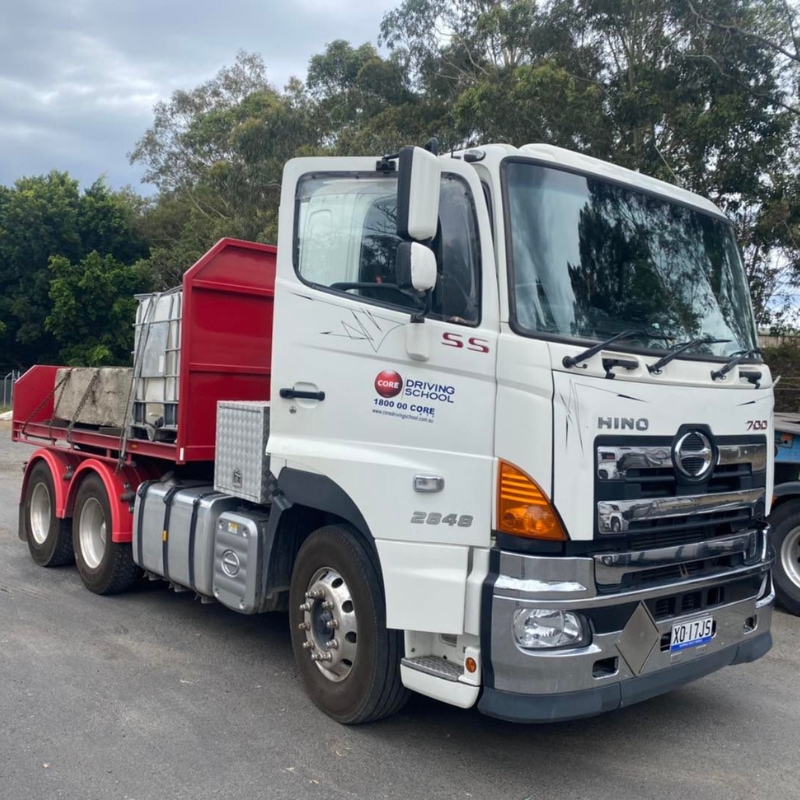
A heavy rigid licence is the highest rigid truck class in New South Wales, and for most Liverpool drivers it is the licence that opens up tipper work, concrete agitators, waste trucks, crane trucks, larger delivery rigids and rigid buses. It sits one step above a medium rigid licence and one step below heavy combination. Getting there is not complicated, but the order matters. You deal with Service NSW first for the knowledge test and the logbook, then you train and get assessed with a registered training organisation. Plenty of people ring us having done those steps in the wrong order, so this guide sets out the sequence, the gearbox decision that catches people out, and what the training day looks like when you come to us for your HR truck licence in Liverpool NSW.
The short version
- An HR licence covers rigid trucks and buses with three or more axles and a gross vehicle mass above 8 tonnes, and it lets you tow a trailer up to 9 tonnes GVM.
- You need to have held a class C licence, other than a learner licence, for two years or more. This is the rule people most often get wrong.
- Service NSW handles the knowledge test, the eyesight test and your HVCBA logbook. Training and assessment happen with an RTO.
- Choosing an automatic or synchromesh assessment puts a condition B on your licence. A road ranger assessment leaves you unrestricted.
- Most drivers finish training and assessment in one or two days, depending on how much heavy vehicle time they already have.
What an HR licence lets you drive
Class HR is defined by the shape of the vehicle, not by what it carries. A heavy rigid vehicle is a single rigid unit, so the cab and the load body sit on one chassis with no turntable in the middle.
Holding an HR licence authorises you to drive:
- Any rigid motor vehicle with three or more axles and a gross vehicle mass over 8 tonnes
- That vehicle towing a trailer, provided the trailer does not exceed 9 tonnes GVM
- Heavy rigid buses, including articulated bendy buses, which are treated as rigid vehicles even though they bend in the middle
- Everything already covered by the light rigid and medium rigid classes
The 9 tonne trailer limit is the line people cross without realising. A tipper and dog trailer, a prime mover and semi trailer, or a truck pulling anything heavier than 9 tonnes GVM all need a combination licence instead. If you want the full breakdown of the vehicle types and the limits that apply to each, we go deeper into what you can drive with an HR licence in NSW.
One thing the licence does not cover
An HR licence covers the vehicle class. It does not cover the job's own regulatory requirements. Driving a route or school bus for a passenger service, for example, also needs a separate bus driver authority on top of the licence class.
Who can apply for an HR licence in NSW
Transport for NSW sets the eligibility rules, and they are not negotiable by a training provider. Before you can train and be assessed for class HR you need to meet all of the following.
- Two years on a class C licence. Have held an Australian class C licence, other than a learner licence, or an equivalent licence, for two years or more. Time spent on a P1 licence counts towards those two years, but you cannot practise in an HR vehicle or upgrade to HR until you hold a P2 or full class C licence.
- Pass the HR knowledge test. Book and sit the heavy rigid knowledge test at a Service NSW centre. You sit this test even if you already hold a smaller heavy vehicle class such as LR or MR.
- Pass an eyesight test. Done at Service NSW when you lodge the application.
- Meet medical requirements where they apply. If you have an existing medical condition, or you are declaring a new one, you need to show that you meet the medical standards that apply to commercial drivers. That evidence has to be in before a logbook is issued or a driving test is booked.
- Collect your HVCBA logbook and guide. Service NSW issues the competency based assessment logbook and learner guide. Bring both to your first training session, because your trainer records your progress in the logbook as you work through the required tasks.
If you hold an overseas licence you will usually need to convert it to a NSW licence first, and you may need your overseas licence or a confirmation letter to prove you held the lower class long enough to count. We set out what nationally recognised training involves, including the units of competency and your rights as a student, in our student information for nationally recognised training.
Where HR sits in the NSW truck licence pathway
Heavy vehicle classes in NSW step up in a fixed order, and each class has its own waiting period. Seeing the whole ladder at once usually makes the right next move obvious.
| Class | What it covers | What you must already hold |
|---|---|---|
| LR | Vehicles over 4.5 tonnes and up to 8 tonnes GVM, or a vehicle that seats more than 12 adults | Class C for one year or more |
| MR | Rigid vehicles with two axles and a GVM over 8 tonnes | Class C for one year or more |
| HR | Rigid vehicles with three or more axles and a GVM over 8 tonnes, towing up to 9 tonnes GVM | Class C for two years or more |
| HC | Combination vehicles such as a prime mover and semi trailer, or a rigid vehicle towing a trailer over 9 tonnes GVM | Class MR or HR for one year or more |
| MC | Multi combination vehicles including B doubles and road trains | Class HR or HC for one year or more |
Notice that LR and MR both only need one year on a car licence, while HR needs two. That is why a driver who has held their class C for eighteen months sometimes starts with a light rigid licence course or an MR instead, gets working and earning in a smaller truck, then comes back for the heavy rigid upgrade once the two years have ticked over.
Coming to HR from a medium rigid licence
A good share of the Liverpool drivers we train already hold an MR and have been driving two axle rigids for a year or two. If that is you, the step up is smaller than you might expect, because the road craft transfers across. What changes is the vehicle.
A three axle rigid is longer, heavier and swings differently. The rear of the body tracks wider through a turn, the braking distances stretch out, and you have to plan entries into tight yards and loading docks much earlier than you would in an MR. That is the bulk of what training focuses on for an MR holder: reading the length of the vehicle and managing the back end.
The eligibility rule still comes from your car licence, not your MR, so you need the full two years on class C before you can upgrade. If you are not quite there yet and you want to keep building hours in the meantime, medium rigid licence training is the usual stepping stone.
Automatic, synchromesh or road ranger: the decision that sticks
This is the single choice on your HR licence that is hard to undo later, and it is worth five minutes of thought before you book.
You can be trained and assessed in three types of transmission:
- Automatic. Easiest to learn in and the quickest route to a pass.
- Synchromesh. A conventional manual gearbox with a clutch and synchronised gears.
- Non synchromesh, usually called a road ranger or crash box. Harder, and it takes longer to get right.
If you are assessed in an automatic or a synchromesh vehicle, your licence is issued with a condition B, which means you may only drive a heavy vehicle fitted with an automatic or synchromesh gearbox. If you are assessed in a non synchromesh vehicle, no condition applies and you can drive any HR vehicle regardless of its gearbox.
Why this matters for work around Liverpool
Newer fleets are increasingly automatic, so a condition B licence will not stop you being hired by a lot of operators. Older tippers, agitators and plenty of regional and civil gear still run road rangers, and a condition B licence rules you out of those seats. If you want every job on the board open to you, do the unrestricted assessment the first time. A condition B can be removed later by passing a short test in a suitable vehicle, so it is not permanent, but doing it twice costs more than doing it once.
We run both automatic and manual heavy rigid vehicles, so you can train in whichever transmission matches the work you are chasing. The full course structure, inclusions and assessment detail sit on our HR licence training and assessment page.
How your training and assessment day runs
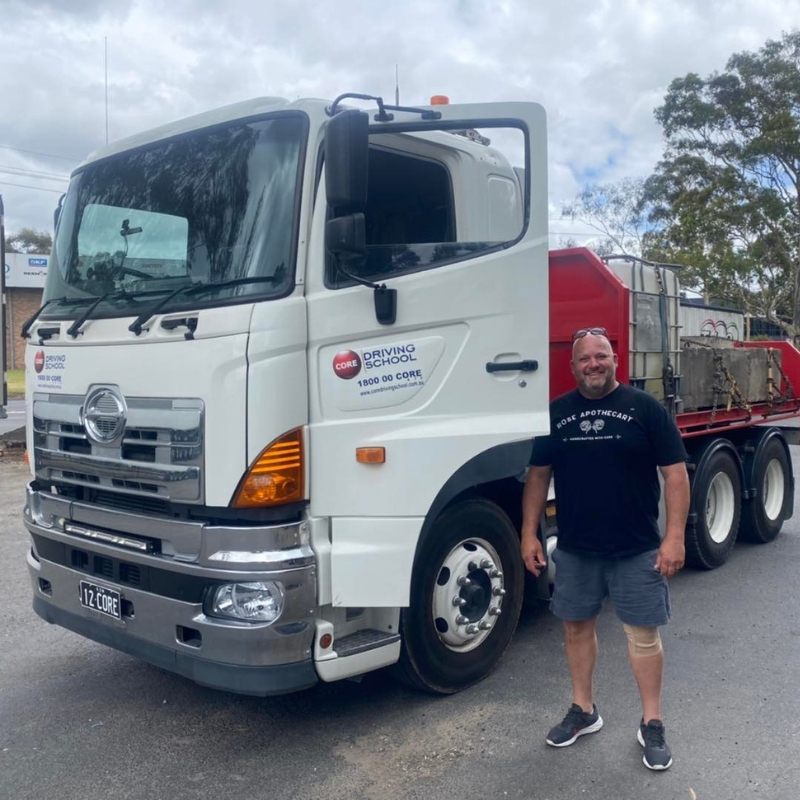
Core Truck Driving School delivers HR training as the nationally recognised unit TLILIC2016 Heavy Rigid Licencing for Driving, assessed through the Heavy Vehicle Competency Based Assessment system. HVCBA sets a minimum amount of training before you can attempt the final assessment, and how much you need depends on the gearbox you have chosen and how much heavy vehicle experience you bring with you.
A typical day follows this shape:
- Pre drive checks and cabin familiarisation. Walk around inspection, coupling and load security awareness, mirror setup, seat and controls, and what the gauges are telling you.
- Low speed vehicle control. Getting the feel of the length, gear selection, clutch and gearbox technique if you are in a manual, and moving the truck accurately at walking pace.
- Manoeuvring. Reversing, kerb side and blind side work, turning in confined space, and judging clearance using mirrors rather than guesswork.
- On road driving. Local streets, then heavier arterial roads and motorway running, covering gap selection, hill starts, roundabouts, lane discipline and turning a long vehicle through suburban intersections.
- Final competency assessment. Once your trainer is satisfied you are at standard, the final assessment is conducted and the result is recorded against the required competencies.
Most drivers complete training and assessment in one or two days. Occasionally we will ask you to put extra time into one specific skill before we put you up for assessment, because sending someone to an assessment they are not ready for helps nobody. Downshifting in a road ranger and reversing accuracy are the two skills that most often need that extra session, and we have written up where drivers most often lose marks in rigid truck assessments if you want to read ahead.
Training near Liverpool: the roads you actually drive
Our training base is at Smithfield, a short drive north of Liverpool, which keeps the trip manageable whether you are coming from the city centre, Casula or further out towards Austral. Training runs seven days a week with flexible start times, so you can fit a course around shift work rather than taking annual leave for it.
More importantly, the roads around Liverpool are genuinely useful ground for learning a heavy rigid vehicle. On a typical course you will work through:
- Tight suburban streets and residential turns, where you learn to track the back of the body properly
- Arterial roads such as the Hume Highway, Cumberland Highway, Elizabeth Drive and Newbridge Road
- Motorway running on the M5 and M7, where merging a heavy vehicle into live traffic is the skill under test
- Industrial access around Smithfield, Wetherill Park, Prestons and Moorebank, which is exactly the kind of yard and dock environment you will be reversing into on the job
We regularly train drivers from Liverpool and the surrounding suburbs:
- Liverpool
- Casula
- Prestons
- Moorebank
- Warwick Farm
- Chipping Norton
- Lurnea
- Cartwright
- Miller
- Hoxton Park
- Green Valley
- Bonnyrigg
- Edmondson Park
- Austral
- Cabramatta
- Canley Vale
- Wetherill Park
- Smithfield
- Fairfield
Beyond south west Sydney we also run courses for drivers in Penrith, Campbelltown, Wollongong, the Central Coast and Newcastle. You can see the full range of truck licence training across Sydney and the classes we deliver in each area.
What an HR licence costs, and what moves the price
There is no single figure, and any provider quoting one without asking you a question first is guessing. Four things decide what you pay.
- Gearbox choice. A non synchromesh course requires more training time than an automatic or synchromesh course, so it costs more.
- Your starting point. A driver coming from an MR with a year of rigid work behind them usually needs less time than someone stepping straight up from a car licence.
- Whether you need extra practice. If a skill needs another session before assessment, that session has a cost.
- Government fees. The knowledge test and the licence issue fee are paid to Service NSW separately from your training, so build those into your budget too.
We quote upfront and we do not add anything at the end that was not in the quote. For a current breakdown of the fees involved and how they stack up, read what an HR licence actually costs in NSW, or call us with your licence history and we will tell you exactly what your situation needs.
The work an HR licence opens up around Liverpool
South west Sydney is one of the busiest freight and construction corridors in the state. The Moorebank intermodal precinct, the industrial estates through Prestons, Wetherill Park and Smithfield, and the amount of residential and civil construction across the Liverpool and Western Sydney growth areas all generate heavy rigid work.
The roles an HR licence typically puts within reach include:
- Tipper and body truck work on civil and construction sites
- Concrete agitator driving
- Waste and recycling collection
- Crane truck and hiab work, where the lifting ticket is a separate qualification
- Larger rigid delivery and distribution runs
- Rigid and articulated bus driving
Worth knowing if buses interest you: the licence class and the authority to carry passengers are two different things. You need the heavy vehicle licence class for the vehicle and a bus driver authority before you can drive a public passenger service.
Your next step after HR: heavy combination
Once you have held your HR licence for twelve months you become eligible for class HC, which covers prime mover and semi trailer combinations and rigid vehicles towing trailers over 9 tonnes GVM. For a lot of drivers this is where the pay step is, because semi work generally sits above rigid work on rates.
Time spent on a P2 HR licence counts towards the twelve months, but you need to hold a full class HR or MR licence before you can practise in an HC vehicle or upgrade. When you are ready, the heavy combination licence course picks up where your HR training left off and focuses on coupling, uncoupling and managing an articulated combination.
Going further: multi combination
Class MC is the top of the ladder and covers B doubles and road trains. You need to have held a class HR or HC licence for at least twelve months to be eligible, and there is one detail worth planning for: if you come to MC from an HR licence rather than an HC, you have to pass an HC level assessment before you can begin MC training.
That makes the HR to HC to MC route the smoother progression for most people. If long haul, line haul or mining work is the goal, multi combination licence training is the destination, and it is worth telling your trainer early so your gearbox choice at HR does not box you in later.
Questions we get asked most
How long does it take to get an HR licence?
Most drivers complete their training and final assessment in one or two days, depending on their experience and the gearbox they have chosen. Before that you need to have sat the knowledge test and collected your logbook from Service NSW, so allow a little lead time for the booking rather than planning to do everything in one go.
Do I need my own truck to train?
No. Training and assessment are conducted in our heavy rigid vehicles, in both automatic and manual transmissions, so you only need to bring yourself, your licence, and your HVCBA logbook and guide.
I am on my green P2 plates. Can I still get an HR licence?
Yes, provided you have held a class C licence other than a learner licence for two years or more. Time on a P1 licence counts towards that two years, but you must hold a P2 or full class C licence before you can practise in an HR vehicle or upgrade to the class.
Should I do my assessment in an automatic or a road ranger?
It depends on the work you want. An automatic or synchromesh assessment is quicker and cheaper, and it gives you a licence with a condition B that limits you to automatic or synchromesh vehicles. A non synchromesh assessment takes longer but leaves you unrestricted and able to drive any HR vehicle. If you are aiming at older tippers, agitators or civil gear, go unrestricted.
What happens if I do not pass the assessment?
You get specific feedback on the competencies that were not met and you can book additional training to work on them before being reassessed. Competency based assessment is about reaching the required standard, not about passing on a particular day, so it is normal for some drivers to need an extra session.
Can I drive a bus on an HR licence?
The licence class covers heavy rigid buses, including articulated bendy buses. Driving a public passenger service also requires a bus driver authority, which is a separate approval from the licence class itself.
Do I have to sit the knowledge test if I already hold an MR licence?
Yes. The heavy rigid knowledge test applies even when you already hold a smaller heavy vehicle class, so an MR or LR licence does not exempt you from it.
How far is your training base from Liverpool?
We train from 14 Tait Street, Smithfield, which is a short drive north of Liverpool and easy to reach from Casula, Prestons, Moorebank, Warwick Farm and the surrounding suburbs. Courses run seven days a week with flexible start times.