

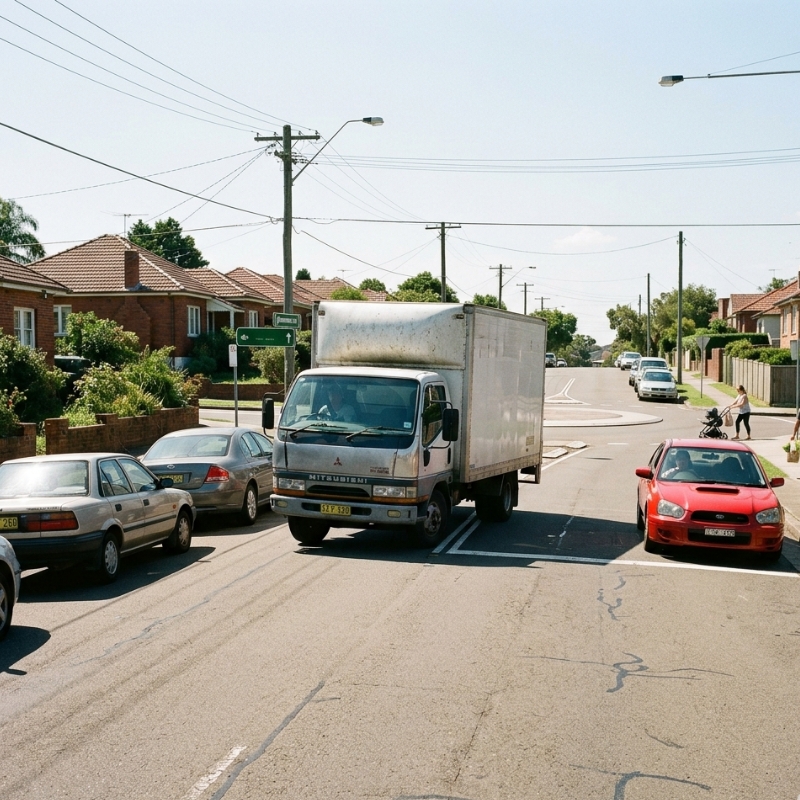
Suburban Sydney can feel deceptively straightforward compared to the CBD or a motorway run—especially when you’re working towards your LR Licence. Then you meet a tight corner with parked cars right up to the intersection, a small roundabout with a splitter island, overhanging branches near the lane edge, and a driver who drifts into your passenger-side blind spot at the worst possible moment.
For new truck drivers, most near-misses in the suburbs don’t come from reckless driving. They come from misjudging three things:
• Your turning path (off-tracking and tail swing)
• Your clearance (height, width, and where your truck actually “sweeps”)
• Your blind spots (and how quickly smaller road users can disappear into them)
This guide walks through the most common mistakes and gives you simple, repeatable routines you can practise on everyday suburban routes. If you’re still getting familiar with vehicle classes and want context for what people mean by “light rigid,” it helps to understand what vehicles you can drive with an lr licence because it anchors the discussion in real-world examples you’ll actually see around Sydney.
Why suburban Sydney catches beginners out
The suburbs create a particular kind of pressure: everything is close, everything is moving, and the road geometry often wasn’t designed with larger vehicles in mind.
Common suburban “gotchas” include:
• Tight corner radii, especially in older neighbourhoods
• Parked cars are narrowing the available turning space
• Roundabouts that vary wildly in size and lane markings
• School zones and shopping strips where pedestrians step out unexpectedly
• Buses pulling in and out, delivery vans stopping suddenly, and utes doing quick lane changes
• Overhanging trees, awnings, and signage that sit right where your truck needs to swing
None of that is exotic driving. But it punishes small mistakes quickly, especially when you’re still building your judgement of space.
Q&A: Why do suburban streets feel harder than highways?
Highways are predictable: lanes are wide, hazards are further away, and traffic mostly flows in the same direction. Suburban streets compress everything—tight turns, parked cars, pedestrians, cyclists, and frequent stops—so your turning path, clearance, and blind spot discipline have to be sharper.
The turning mistakes that cause kerb strikes and sideswipes
Mistake 1: Starting the turn too early
This is the classic beginner error. You begin steering before your rear axle (and rear wheels) have actually cleared the corner. The result is often:
• Rear wheels riding up onto the kerb
• Cutting across a pedestrian refuge or splitter island
• Clipping a parked car with the rear body
What it feels like in the moment is misleading: your front clears, so you assume the truck will follow. But the rear follows a different line.
What to do instead
Think: delay, then steer. Give the rear time to clear.
A practical cue you can test (and adjust based on your vehicle) is:
• On a left turn, don’t commit to the steering input until your shoulder is roughly aligned with the corner you’re turning around. If you’re not sure, slow down and take the extra half-second to confirm the rear has room.
Mistake 2: Forgetting off-tracking
Off-tracking is when the rear wheels follow a tighter path than the front wheels. It’s a big reason kerb strikes happen on suburban corners.
Off-tracking gets worse when:
• The corner is tight
• You turn sharply at low speed
• You’re in a longer wheelbase vehicle
• You’re forced to “hook” the turn around parked cars
What beginners think: “My front wheels cleared it.”
What actually happens: your rear wheels cut in.
What to do instead
Before you turn, identify the “pinch point” (parked cars, a signpost, a splitter island, a kerb that sticks out). Then:
• Set your lane position early to protect the rear wheels
• Reduce steering sharpness by creating space (where safe/legal)
• Keep speed very low so you can adjust mid-turn without panic
Mistake 3: Underestimating tail swing
Tail swing is the opposite issue: when the front pivots, the rear of the vehicle can swing outward before it follows the turn.
This tends to bite beginners when:
• Pulling out from the kerb near shops
• Leaving a worksite or loading bay
• Turning from a narrow street into a wider one
• Negotiating a small roundabout with tight entry geometry
What to do instead
Before you move off:
• Check mirrors for anything alongside your rear corners (cars, cyclists, bins, poles)
• Move off slowly and watch the rear corner as the vehicle pivots
• Treat the first metre as the “danger metre” for tail swing—nothing should be close to your rear corner in that moment
Mistake 4: Hugging the kerb because it feels “polite”
A lot of beginners try to be courteous by staying tight to the kerb. In a truck, that often backfires because it removes your turning room and worsens off-tracking.
Sometimes, the safer option is to position yourself to create space for your swept path. The key is doing it early, smoothly, and predictably—no last-second swerves.
A simple lane-position routine
• Signal early
• Check mirrors early
• Choose a position that protects your rear path (within your lane, where possible)
• Commit smoothly and keep the speed at a walking pace when it’s tight
Q&A: Why do trucks sometimes take up more than one lane to turn?
Because your vehicle needs space to avoid off-tracking and tail swing hazards—and to prevent the rear wheels or rear corner from cutting into kerbs, islands, pedestrians, or vehicles alongside you. Transport for NSW also reminds road users that trucks have larger blind spots and need space, which is why clear, predictable positioning matters for everyone around you.
Roundabouts in the suburbs: the mistakes that create chaos
Roundabouts are where suburban pressure peaks: everyone wants through quickly, the space is tight, and smaller road users often try to slip past.
Mistake 5: Entering too fast “to keep traffic moving”
Beginners often rush through roundabouts because they feel they’re holding up cars behind them. But the hazards at roundabouts are exactly what you need time to manage:
• A car approaching quickly from the right
• A cyclist filtering up on the left
• A pedestrian stepping off near the exit
• A tight central island forcing sharper steering than expected
What to do instead
Adopt this mindset: your job isn’t to be quick—it’s to be smooth and obvious.
A strong entry habit
• Slow early
• Check right, then mirrors
• Enter at a speed where you can stop if the gap collapses
• Keep the steering arc gentle rather than sharp
Mistake 6: Cutting too close to the centre and clipping islands
This is usually off-tracking plus speed. The fix is boring but effective:
• Enter wide enough to keep a gentle arc
• Hold your lane (don’t “cut” the circle)
• Keep speed low so you’re not chasing the steering wheel
Mistake 7: Planning the exit late
Late exit planning causes late steering and late mirror checks—exactly when cyclists and small cars try to appear beside you.
What to do instead
• Decide your exit as you approach
• Signal at the appropriate time
• Check mirrors before you change position, not during
Q&A: What if a roundabout feels too small for my truck?
Slow down early, don’t commit until you can see a safe path, and be willing to wait. If your swept path needs more room, reposition before entering rather than forcing a tight turn. If you’re consistently unsure at roundabouts, it’s a sign you need more supervised practice in low-speed manoeuvring.
Clearance mistakes: height, width, and the “sweep” you forget about
Clearance issues in suburban Sydney aren’t just bridges. They’re often closer and less obvious.
Common suburban clearance hazards
• Low branches over the lane edge
• Awnings and signage near shopping strips
• Powerlines and tree canopies on narrow streets
• Driveway overhangs and tight property entrances
• Narrow lanes where your body or load swings wide during a turn
Mistake 8: Only thinking about height
Beginners often ask, “Will I fit under it?” The better question is, “Will my truck or load sweep into it as I turn?”
Turning changes your clearance envelope:
• The front can swing wide (front overhang)
• The rear can swing wide (tail swing)
• The body can move closer to roadside obstacles than you expect
What to do instead
Use a two-step clearance scan:
- Before the turn
• Look high first (branches, awnings, signage) - During the turn
• Track the side hazard (poles, parked cars, kerbs) using your mirrors
Mistake 9: Not using a “reset” when it feels wrong
New drivers sometimes push through because they feel watched. In the suburbs, a reset is often the safest move.
A safe reset could be:
• Pause before committing
• Roll forward slightly to widen the arc
• Wait for the opposite lane to clear (where legal and safe)
• If you’re not confident, don’t force it—reposition calmly
Q&A: What should I do if a street or turn feels too tight?
Slow down early and give yourself options. If you can’t clearly see a safe path for your rear wheels and your clearance envelope, don’t gamble. Stop, reassess, and reset your position. If necessary, take an alternate route rather than forcing a tight manoeuvre.
Blind spot mistakes: the ones that cause the scariest near-misses
Blind spots are where suburban traffic can behave unpredictably: cars creep up the inside, cyclists appear alongside you, and motorbikes vanish next to the cab.
For new truck drivers, the goal isn’t “eliminate blind spots” (you can’t). The goal is to manage them actively—especially before you slow, signal, or turn.
For broader safety reminders on blind spots and giving trucks space, Transport for NSW’s Be Truck Aware page is a solid reference.
Mistake 10: Mirror checks as a “tick” instead of information
A quick flick to the mirrors doesn’t help if you don’t process what you’re seeing. Blind spot management is about:
• Where is the nearest vehicle?
• How fast are they closing?
• Are they staying beside me?
• Do I need to slow down to let them pass or create space?
What to do instead
Adopt a rhythm in busy suburbs:
• Mirrors every 5–8 seconds
• Mirrors before braking
• Mirrors before signalling
• Mirrors again before changing lane position
Mistake 11: Signalling but not creating space
Signalling doesn’t move vehicles out of your blind spot—space does.
If you need to move left:
• Check mirrors
• Ease off slightly to let the vehicle ahead clear
• If a car is sitting alongside, wait it out
• Only move when you can see it’s safe
If you need to move right:
• Same principle: build a gap rather than forcing one
Mistake 12: Turning while someone is “hiding” on the inside
One of the most dangerous suburban patterns is the inside pass during a left turn. You reduce the risk by:
• Positioning early (so you’re not inviting an inside squeeze)
• Signalling early
• Re-checking the left mirror before and during the turn
• Keeping speed low enough that you can stop if something appears
Suburban Sydney scenarios that trip up new truck drivers (and what to do instead)
Scenario 1: Left turn into a narrow street with parked cars near the corner
Common mistake
• Hugging the kerb and turning early
Do this instead
• Slow early
• Set up within your lane to protect the rear wheels
• Delay steering until the rear can clear
• Watch the rear in the left mirror as you turn
Scenario 2: Pulling out from the kerb near shops or a worksite
Common mistake
• Forgetting the tail swing and focusing only on the front
Do this instead
• Check mirrors for anything besides your rear corners
• Signal early
• Move off slowly
• Watch rear corner movement as the front pivots out
Scenario 3: A small roundabout with traffic pressure behind you
Common mistake
• Entering too fast to avoid “holding people up”
Do this instead
• Approach slow enough to stop
• Choose a gentle arc and hold it
• Plan exit early
• Keep scanning mirrors (cyclists and scooters love roundabouts)
Scenario 4: Turning right at an intersection with impatient drivers
Common mistake
• Late lane changes and late mirror checks
Do this instead
• Plan your lane choice early
• Signal early
• Build a gap rather than forcing one
• Keep the manoeuvre smooth and predictable
A simple “suburban three-check” routine you can use every time
Before any turn, lane change, or tight negotiation, run:
- Turning path
• Where will my rear wheels go?
• Where could the tail swing hit? - Clearance
• What’s above me?
• What’s beside me as I sweep through? - Blind spots
• Who’s beside me right now?
• Who could appear beside me as I slow and turn?
If you can’t answer those quickly, slow down until you can.
When you should get supervised practice (instead of hoping it “clicks”)
If any of these keep happening, it’s a sign you’ll improve faster with guided coaching:
• You regularly clip kerbs on left turns
• You’re unsure about lane positioning on tight corners
• You’ve had repeated near-misses with vehicles beside the cab
• You freeze at roundabouts because you can’t judge your swept path
• You don’t feel confident estimating clearance in everyday suburbs
It also helps to make sure you’re working within the right licence class and conditions for the vehicles you’re driving. If you’re double-checking prerequisites, LR licence eligibility in NSW is a handy reference, and when you’re ready to understand what structured practice typically covers,
FAQ
What’s the biggest turning mistake new truck drivers make in the suburbs?
Starting the turn too early. Your front clears, but your rear wheels cut in (off-tracking) and strike the kerb, a sign, or a parked car. Delay the turn until you’ve created space for the rear.
What is tail swing, and when does it happen?
Tail swing is when the rear of the truck swings outward as the front pivots (often when pulling away from the kerb or turning tightly). It’s dangerous because the hazard is beside and behind you, not in front.
How do I avoid hitting the kerb on left turns?
Slow down early, set up your lane position to create turning room, delay the steering input, and watch your left mirror to track the rear wheels through the turn.
Why do blind spots feel worse in suburban Sydney?
There’s more stop-start movement, more cyclists and delivery vehicles, more parked cars narrowing lanes, and more moments where drivers try to slip past you as you slow and turn. You need a tighter mirror-check rhythm and more deliberate gap creation.
What’s the safest approach to small roundabouts?
Approach slow enough to stop, hold a smooth arc (don’t cut in sharply), plan the exit early, and keep scanning mirrors—especially for cyclists, scooters, and cars trying to sneak alongside.
How can I judge clearance better?
Think “clearance envelope,” not just height. Look above for branches/awnings/signage, and also consider how your truck sweeps sideways during turns (front swing, rear swing, and body movement).
If I’m unsure, should I just go slowly and hope for the best?
Go slowly, but don’t rely on hope. If you can’t clearly identify a safe path for your turning line, clearance, and blind spots, stop and reset your position—or take an alternate route if needed.